
Korea Accounting Essentials
- 01 What this guide covers
- 02 KRW & multi-currency invoicing
- 03 VAT organization
- 04 E-tax documents & record keeping
- 05 Statutory reporting needs
- 06 Working with a Korean tax agent
- 07 English reporting for mixed teams
Bryskalon explains workflow and organization only. Filing and interpretation stay with a licensed professional in Korea.
Reading the Korean ledger
How do KRW, VAT, and e-tax fit together?
Operating in South Korea means running daily books in KRW while keeping VAT records, e-tax documents, and statutory reports organized. Cloud accounting helps by structuring invoices, expenses, and ledger entries consistently. Final filing steps usually involve coordination with a licensed professional and national systems.
Updated for the 2026 filing cycle. Organization guidance only — your accountant handles submission.
This page
What this guide covers
Seven short chapters, read in the order a founding team meets them — from invoicing in KRW through to the English reporting a mixed Seoul team shares with investors. Every chapter names what the tool does and where a licensed professional takes over.
Chapter 01
KRW invoicing with foreign clients
Issue invoices in KRW for domestic clients and in the agreed currency for overseas work, with exchange details noted clearly. Tools associated with multi-currency support — such as Xero and Zoho Books in 2026 coverage — can organize those invoices in one ledger. Confirm how your chosen tool displays KRW totals for local review, because the whole point is that whoever checks the books can follow the line back to the source.
Clear naming prevents confusion at quarter-end. When two currencies live in the same file, name the invoice with the currency and the client in the title, keep a short memo of the rate you used, and never overwrite the original — a correction is a new line, not an edit.
Rows show how a multi-currency ledger separates the two invoice types. Only the matched exchange note carries the signal.
Chapter 02
VAT organization, not filing shortcuts
VAT compliance in cloud accounting means complete, categorized sales and purchase records, attached tax invoices, and clean period totals. Bryskalon explains organization and workflow only: your accountant verifies categories and handles submission through the proper e-tax channel. Keep digital copies filed by tax period, and attach the matching tax invoice to every sales and purchase entry as you go — reconstructing that trail in the week before a deadline is what usually goes wrong.
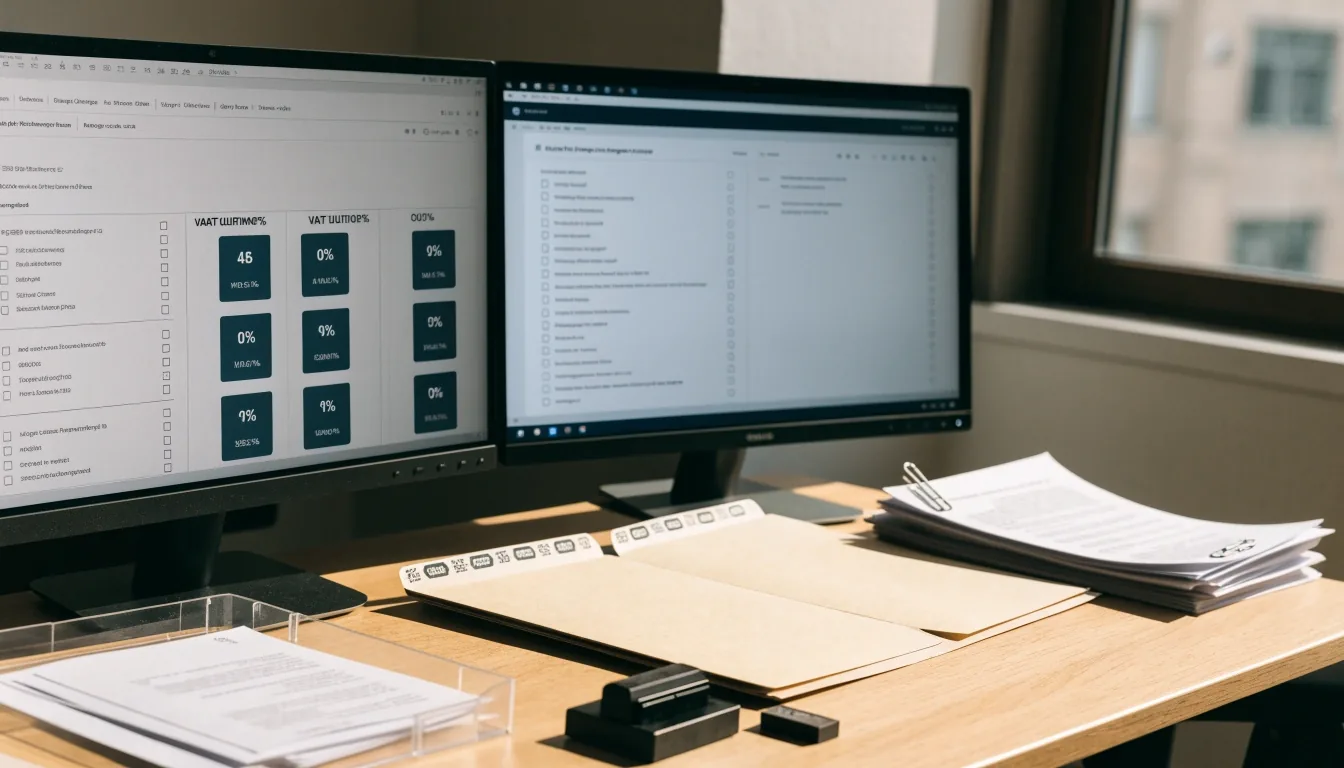
Period totals agree — submission stays with your accountant.
Screenshot in this band is the desk where the period close happens, not a live filing screen. Bryskalon does not submit on your behalf.
Chapter 03
E-tax documents and record keeping
E-tax filing in Korea relies on structured electronic records. Store issued and received electronic tax documents where your bookkeeper can find them, linked to the matching ledger entry. Note cancellations and corrections rather than deleting lines — that history keeps audits and reviews straightforward.
Issued
Electronic tax invoices you issue to clients. File by period, keep the matching ledger line.
Received
Documents your suppliers send. Attach them to the purchase entry, not the folder behind it.
Cancellations & corrections
Never delete the original line. Add a note and the next document number, so the sequence stays whole.
What to keep together
The e-tax document, saved by period.
The ledger entry it belongs to.
The bank feed line that settles it.
Any cancellation or correction, with the reason.
Chapter 04
Statutory reporting needs
Statutory reporting draws on the general ledger, accounts receivable, accounts payable, and payroll summaries. Consistent month-end close, including reconciliation, makes those reports easier to prepare — and it makes the figures trustworthy, because the bank lines have already been matched against the books.
Larger or multi-entity businesses using ERP-style systems lean on consolidation features for group views. Smaller firms can manage with disciplined monthly review: close the month on time, match the bank feed, and write down anything you had to make a judgement on so the next month starts from a known position.
The close, in order
-
1. Match the bank feed
Every statement line resolves to a ledger entry or an explanation.
-
2. Clear AR and AP
Paid stays paid, owed stays owed, ageing doesn't get older than it should.
-
3. Post payroll summaries
Wages, withholdings, and employer contributions land in the right period.
-
4. Note judgements
Two lines on anything you had to decide, so next month starts clean.
Chapter 05
Working with a Korean tax agent
Bring reconciled books, bank statements, invoice registers, and expense receipts grouped by month. Note any USD or JPY invoices and how they were converted — that note saves a conversation at the table. Ask what the agent wants coded differently next period, then save that as a rule in your software, so the same conversation doesn't repeat in three months.
Two short meetings a year beat one long correction in December. Book a light review mid-year when your books are still small, and bring the questions you have been carrying rather than a folder of problems.

Chapter 06
English reporting for mixed teams
Many teams in Seoul operate in Korean for filing and English for management. Keep account names consistent, add English memos to Korean invoices, and export management reports in English for founders. Agree on one chart of accounts so both languages point to the same numbers — a second chart built for convenience quietly becomes the reason two versions of the month disagree.
When a report leaves the building for an investor or a foreign parent, the memo is the translation: it says what the line contains, which currency it was booked in, and what changed this month. The export stays in the software's own structure, so nothing is retyped.
Questions
Common questions
Answers to the questions founders ask first. When the question turns on your own entity or filing history, the agent or a licensed professional in Korea is the person to ask.
Can cloud software handle Korean VAT and e-tax alone?
Software organizes invoices, expenses, and ledger totals that support VAT and e-tax workflows, but filing and interpretation need a qualified professional in Korea. Use the tool for clean records and weekly reconciliation, and your agent for review and submission.
Do I need a chart of accounts in Korean as well as English?
One chart of accounts, labelled in whichever language the reader needs, is the version that stays true. If your accountant reads Korean names and your management reporting is in English, keep the mapping in one place so a single account code answers to both — never maintain two separate lists.
How often should books be reconciled in a Korean business?
Weekly reconciliation is the habit that keeps month-end close short. Match the bank feed while the transactions are still fresh, categorize as you go, and keep the monitored state small — the morning of the filing deadline is not the time to be deciding what a payment was for.
What should I bring to a meeting with a Korean tax agent?
Reconciled books, bank statements, invoice registers, and expense receipts grouped by month. Add a note on any invoice booked in USD or JPY and how it was converted. Leave the questions you already know you have at the top of the folder — that is what the meeting is for.
Bryskalon publishes workflow and organization guidance for teams operating in Korea; we do not file on your behalf and we do not provide tax advice.
Where to go next
Keep reading, or bring a question to Bryskalon
The compliance side works best when the reconciliation habit underneath it is already in place. If this page raised a question about invoicing or expenses, the two guides below cover the daily workflow. If you would rather talk it through for your own entity, the address and hours are real and someone reads them.
- See bank reconciliation basics How matching a bank feed to the ledger works, month to month.
- Invoicing and expenses guide Building the invoice register and expense trail a filing relies on.
- Compare platforms for Korea use Multi-currency support, KRW display, and how each tool organizes periods.
- Contact Bryskalon 26 Eulji-ro 5-gil, Jung-gu, Seoul 04522 · +82 2-6473-3408 · [email protected]
Office hours: Monday to Friday, 9:00 AM – 6:00 PM.